
Cladding Cleaning Chemicals: What's Safe on Each Panel Type
Published November 2026
By Peter Gama, Exterior Cleaning Solutions, Northampton. IPAF and CSCS certified.
Short answer: A diluted sodium hypochlorite solution (1-3%), with a short dwell time and a rinse with clean, low-pressure water, can kill algae without harming the finish of most factory-coated steel cladding on UK warehouses and industrial units. Bleach can stain, etch, or weaken the surface of anodised aluminium, some aluminium composite panels, and timber, so the rules change for those. The risk of damaging cladding from strong solvents, abrasives, and high-pressure jets is higher than the risk from the chemical itself. So, start with testing a small, less visible area. If the building is still under guarantee, review the panel maker's maintenance guide.
If you’re a building manager and you got a quote from a contractor for cladding cleaning, here’s what you need to know about the chemistry before any hoses get out. Visit our cladding cleaning page if you’re only interested in the service itself.
Why the chemical matters more than the pressure
Typically, the commercial cladding in the UK is pre-finished steel: a steel sheet with a factory-applied paint system. The paint serves as a weather barrier. When damaged, the problem goes beyond appearance; it will shorten the durability of the building envelope.
Two kinds of dirt collect on cladding:
- Biological growth - green and black algae, lichen, bacterial films. Not only is it alive, but it also grows back, so the chemical has to kill it.
- Atmospheric soiling - traffic film, industrial fallout, dust. As it’s not alive, it can be lifted with water, detergent, or heat.
With the correct diagnosis, far less chemical than most people expect will be necessary. In April 2026, we cleaned a light-industrial unit in Dunstable. The build-up was road film and general grime, and some light biofilm along the plinth. We only used hot water. We didn’t use chemicals and didn’t apply biocide, as there was nothing to use it for. The client declined biocide.
How to tell what your cladding is made of
Someone has to detect the panel type before choosing the chemical. Typically, you only need a few minutes and can do it from the ground:
- Look at the profile. In warehouses and industrial units, most trapezoidal or corrugated sheets are factory-coated steel. Many offices and retail frontages have flat, smooth panels with tight joints, typically aluminium composite or rainscreen panels.
- Try a magnet on a panel or flashing you can reach. If it’s steel, it will stick. It doesn’t stick to aluminium. This matters because alkaline cleaners react differently with aluminium finishes.
- Check the age and the texture. Grey, fibrous corrugated sheets on older warehouses and farm buildings can be fibre cement. If the sheets were installed before 2000, they might contain asbestos. Before any pressure is applied, a survey is necessary.
- Ask for the O&M manual. Operation and maintenance documents accompany newer buildings. They mention the name of the cladding system, the coating and any guarantee. That's the most reliable source; the maker's own cleaning instructions are typically included.
- Do a chalk test. Rub a finger across a sun-facing panel. If there’s powdery residue, the paint is probably weathering. This changes the results of the cleaning (more on that below).
The contractor can’t tell what the panel is? Then, they can’t tell which chemical is safe to use for cleaning either.
Chemicals by panel type
| Panel type | What usually works | Use with care / avoid |
|---|---|---|
| Factory-coated steel (polyester, plastisol, PVDF on steel) | Detergent wash for grime; 1-3% sodium hypochlorite for algae; DDAC biocide after | Solvents on plastisol/PVDF without a test; high-pressure jets; abrasive pads |
| Anodised aluminium | Neutral (pH-neutral) detergent, soft brush, clean rinse | Bleach and other alkaline cleaners - they attack the oxide layer |
| Aluminium composite panels (ACM) with PVDF/polyester finish | Mild detergent per the panel maker's guide | Some makers prohibit hypochlorite outright - read the O&M manual first |
| UPVC / plastic cladding | Low-pressure soft wash, diluted hypochlorite | High pressure (warps panels, drives water behind seals) |
| Timber | Very dilute solution or oxygen-based (percarbonate) cleaner, surface pre-wetted | Strong bleach on dry wood - degrades the fibres |
| Fibre cement | Soft wash, diluted hypochlorite, biocide | High pressure on old sheets; treat any pre-2000 sheet as possible asbestos until surveyed |
Sodium hypochlorite: what it does and how strong it should be
Sodium hypochlorite is the active ingredient in bleach. It’s used for exterior cleaning because it kills algae, lichen and mould at the root level. It doesn’t just wash the top layer off. Concentration matters, as it’s alkaline and an oxidiser.
Based on what we have to kill, we use between 1% and 3%. We use the low concentration against light green algae, and the highest concentration for visible black growth and lichen. There’s a reason against that range. According to Tata Steel's own Colorcoat maintenance manual, the successful fungal-growth mix is around 1.25% hypochlorite. US cladding maker Petersen Aluminium's cleaning guidance for its coated panels recommends a mildew solution of one quart of 5% hypochlorite to three quarts of water plus detergent, bringing the total to around 1.25%. Guidance for pre-painted steel from U.S. Steel Košice also names diluted household bleach for stubborn mildew.
The rules to follow:
- Pre-wet the surface; the solution shouldn’t soak in, but sit on the surface.
- Short dwell - usually 5 to 15 minutes, long enough to kill the growth. It should never be left to dry on the panel.
- Rinse with clean, low-pressure water, top to bottom.
- Protect what's around it - plants, glazing seals, anodised window frames, people.
Always test a patch first
Before we treat an entire elevation, we test a small, inconspicuous area. It only takes ten minutes, and we see how the finish will react. We’ve never had adverse reactions on industrial coated-steel cladding. However, not all panels are industrial coated steel, and an older or repainted finish can react differently than a new one. One thing all panel manufacturers agree on: before using the cleaners at scale, always test on a small, less visible area.
Stains that cleaning chemicals won't fix
Not all marks on cladding are dirt or algae. Avoid poor results by learning to make the difference before paying for cleaning:
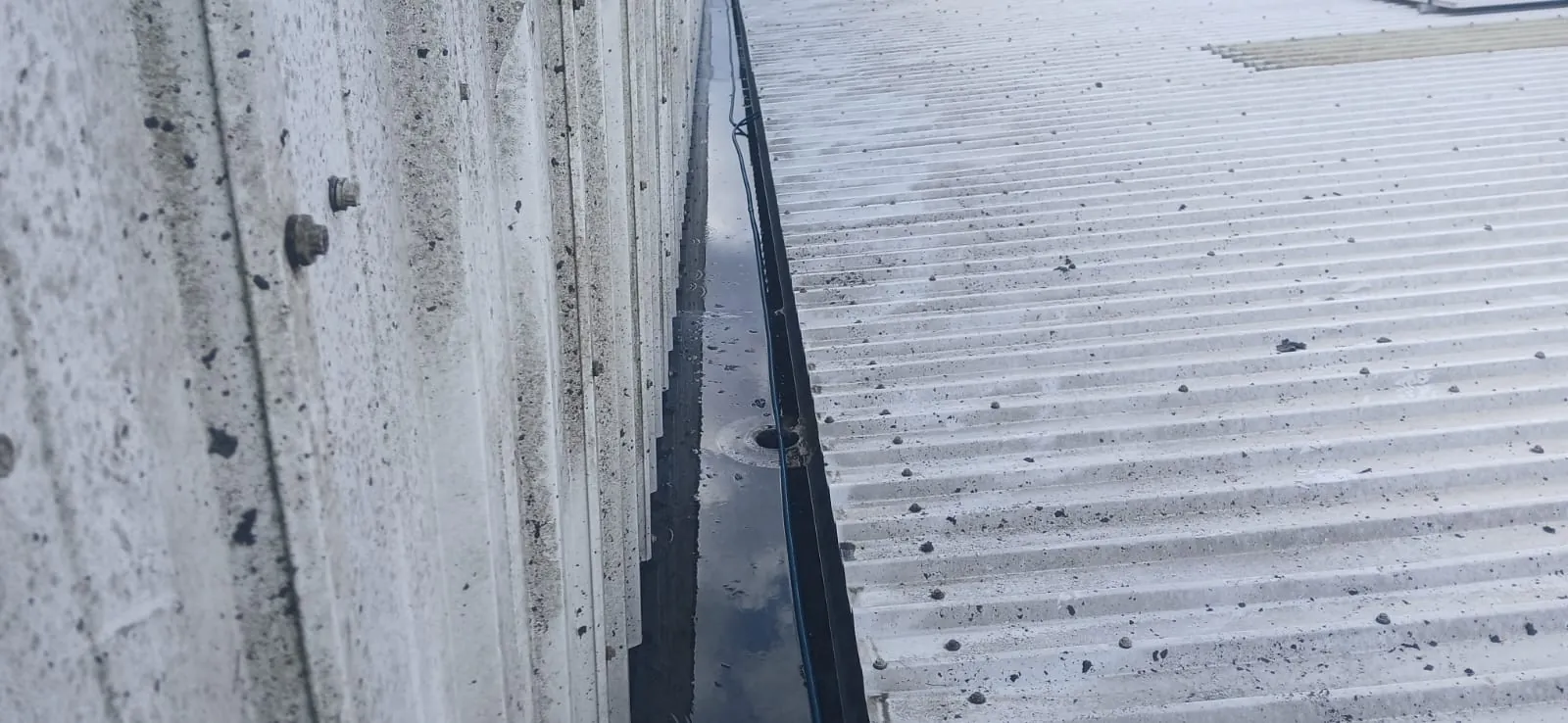
- Chalking. Under UV light, polyester and plastisol coatings slowly break down, leaving a chalky surface. Washing eliminates the loose chalk and the collected dirt. While this won’t restore the original gloss, the panels will look better. As plastisol chalks heavily, rain keeps it cleaner. On a wall facing south, faded colour isn’t soiling; it’s paint ageing.
- Rust stains from cut edges, fixings or metal swarf left behind during installation. Manufacturers use certain diluted acids to treat these. This differs from removing algae, and areas around coatings require extra care.
- Tar, oil, sealant and graffiti. Solvents are necessary for these; many coatings can be damaged by solvents. Some solvents used on PVDF finishes aren’t allowed on silicone-modified polyester. Open tins after identifying the coating and testing. Pay attention to protective treatments as well. According to Tata Steel warnings, using semi-permanent anti-graffiti layers voids its guarantees.
- Lichen ghosting. Lichen adheres more strongly than algae. The chemical will kill it. However, on older finishes, marks of its former growth remain visible for some time even after cleaning.
Are you looking at chalking or fading? Truth be told, cleaning will improve it, but only a recoat will restore its appearance.
Not Sure What Your Cladding Is Made Of?
We identify the panel and finish on site before we quote a chemical, and we test a patch before treating an elevation. No upfront deposits, fully insured to £5 million, and backed by 114 five-star Google reviews. Call 07307 358765 for a free assessment.
Get a Free QuoteWhat manufacturers say (and why it varies)
There’s no one-size-fits-all industry rule. Here’s how the guidance varies:
- Tata Steel (Colorcoat) recommends washing with clean water and a soft-bristled brush. No high-pressure jets should be used. They also recommend testing for compatibility before using a cleaning product. For fungal growth, the recommended mix is: 0.5% household detergent, 3% trisodium phosphate, 25% of a 5% sodium hypochlorite solution and 71.5% water. The surface should be pre-washed, and the mix has to be applied by low-pressure spray or brush. Thorough rinsing with clean water should follow. In the end, the concentration should be around 1.25% hypochlorite. The cleaning contractor is responsible for following this guidance.
- Some aluminium panel makers forbid bleach, chlorine or hypochlorite on PVDF-coated aluminium. They also warn that using these may impact warranty eligibility.
- Anodised aluminium is vulnerable to alkaline cleaners. They attack the protective oxide layer.
- Timber: the US Forest Products Laboratory highlights that, while bleaching agents kill algae and mould quickly, they can also damage wood. So, dilute solutions as much as possible.
One principle all manufacturers agree on: no abrasives, no wire brushes, no aggressive scrubbing, and a thorough rinse. The easiest way to void warranty? Using the cleaning agents incorrectly.
Do you need a biocide as well?
Sodium hypochlorite kills what's there. Applied after cleaning, the DDAC (quaternary ammonium) biocide slows what follows; it remains on the surface and activates every time it rains. On north-facing walls and elevations, it makes the difference between cleaning every year and cleaning only every several years. For how often commercial cladding should be cleaned, with and without a biocide, see our maintenance guide; for how a biocide works on roofs and how long it lasts, see our biocide guide.
Biocide isn’t always necessary. Soiling that is atmospheric with little biological growth for the most part - like the Dunstable unit - there's nothing to stop regrowing.
Protecting people, plants and drains
The method statement doesn’t refer to the chemical used. It also must explain what happens with the runoff:
- Plants and grass are watered before treatment and rinsed after the cleaning. This way, the diluted solution doesn't sit on leaves.
- Glazing, seals and window frames are rinsed at once. While an alkaline solution is fine on coated steel, it can mark anodised aluminium window frames at the same elevation.
- People and vehicles are restricted from the working area with barriers and signage. This matters most on sites that don’t close during the clean, such as retail car parks.
- Run-off. In England, surface water drains discharge straight to the environment, usually the nearest stream or river. Contaminated wash water must go to the foul drain (with the water company's permission), be recycled, or be removed by a registered waste carrier (GOV.UK pollution prevention guidance for businesses). On commercial jobs, we first find out which drains are surface water and which are foul; we never assume. We cover or seal the surface water drains, contain the run-off with sandbags, water-filled barriers or temporary bunding, collect it with a wet vacuum or recovery pump, and dispose of it legally. Ask your contractor for an answer tailored to your site, not a generic one.
On our commercial quotes, our method statement includes notes on how we will protect nearby areas, vegetation and sensitive surfaces before we start. We write it right next to the chemical and the treatment steps. Doesn’t the quote you got include any notes on it? Please ask us why.
What this looks like on a real job
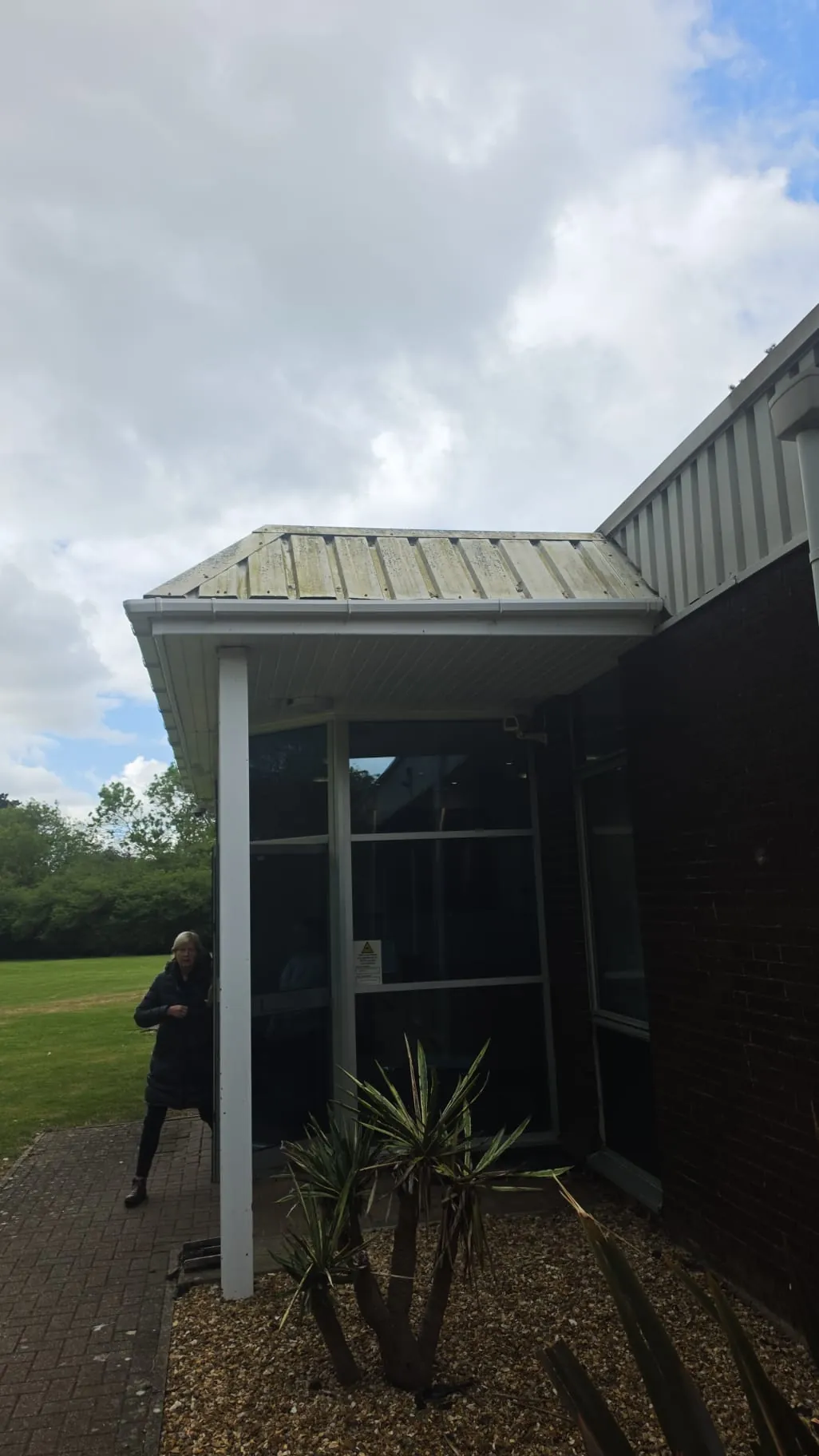
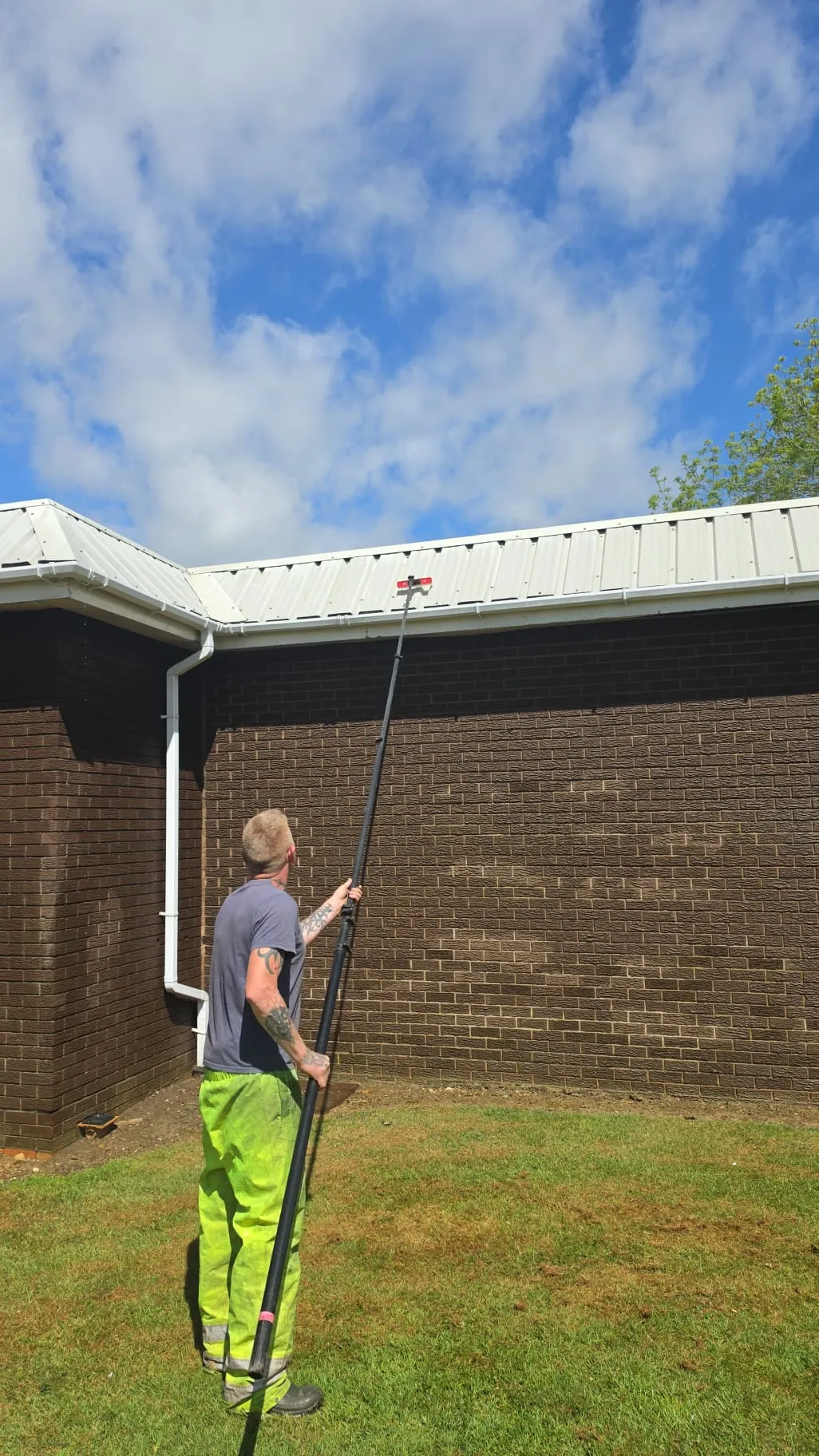
At Eurofins BLC in Northampton (May 2026), yellow-green algae streaks coming down from the gutters covered the profiled metal cladding and sloped porch roof. Working from ground level with telescopic poles (see how to clean high-level cladding safely), we soft-washed with sodium hypochlorite at low pressure. Afterwards, we rinsed and hand-brushed the porch panel. Without hiring a platform, we turned the stained porch into a clean cream in an afternoon.
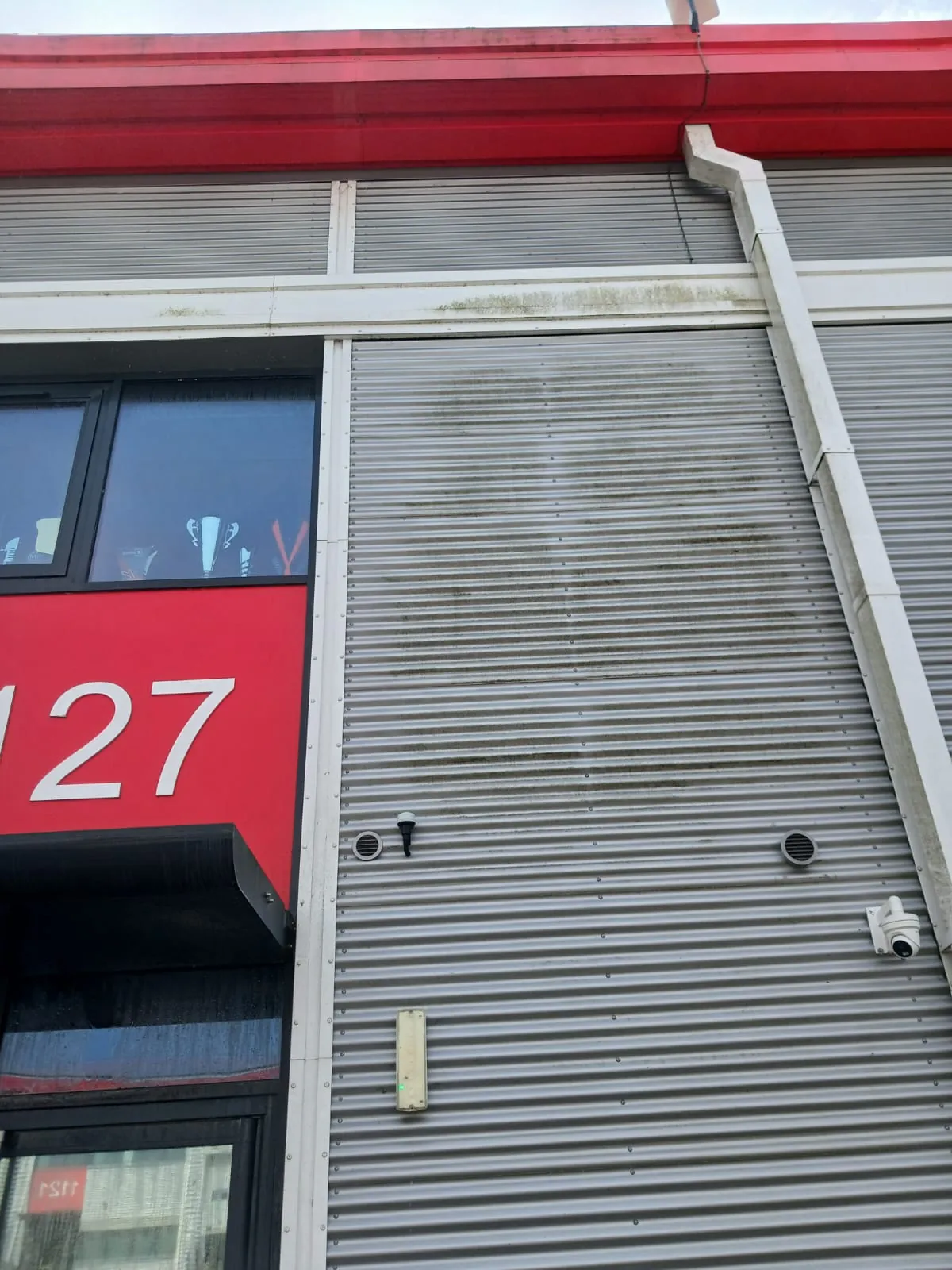
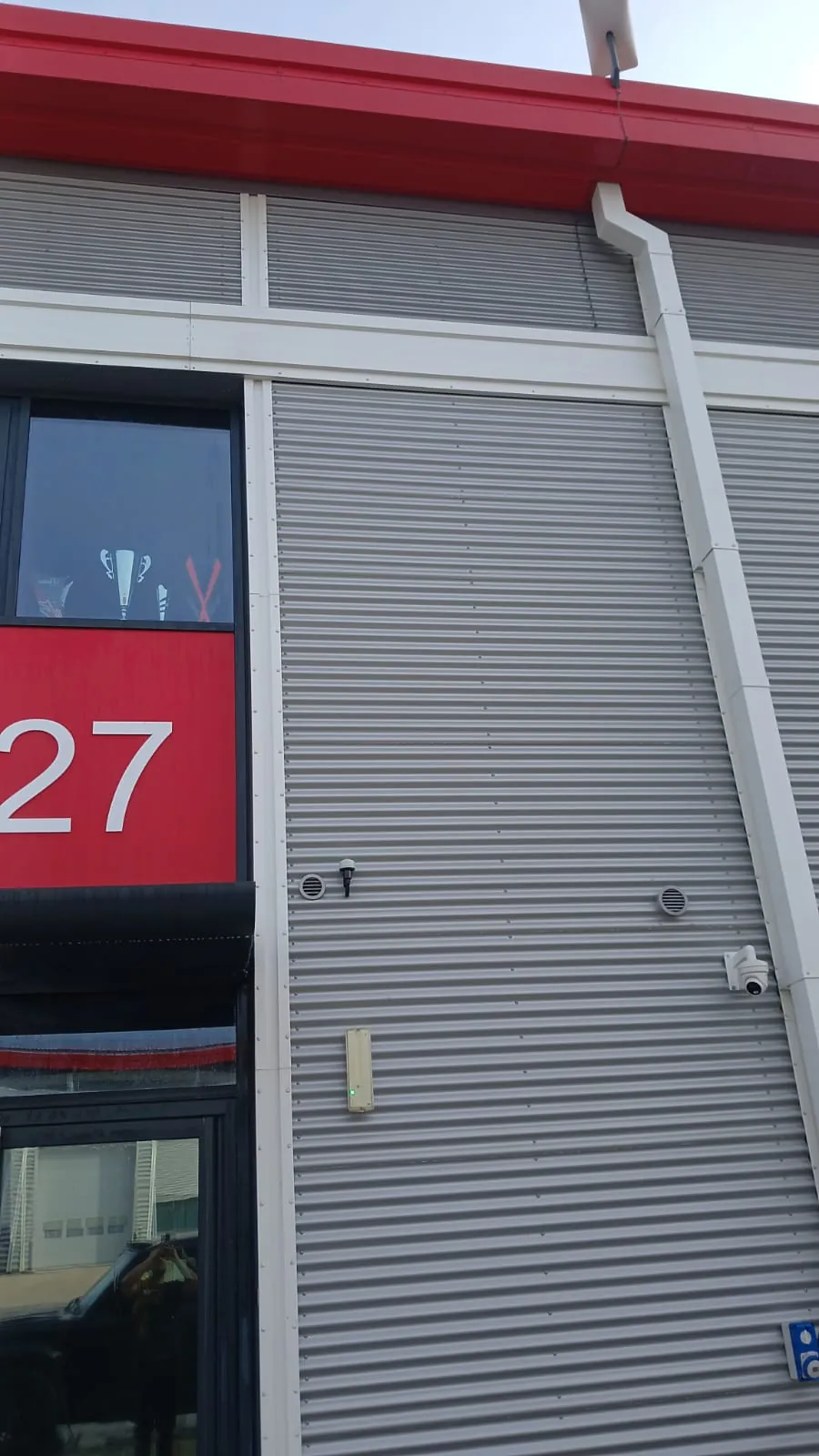
At a motorsport unit on Silverstone Business Park (March 2026), the horizontal flashings and the mini-corrugated panels below them had green algae colonisation. We used hypochlorite, allowed it to dwell, and rinsed lightly. To prevent regrowth, we’ve also applied DDAC biocide.
A checklist for facility managers
Here’s what you need to find out from the contractor before you sign off a cladding clean:
- What is the panel and finish, and how did you identify it?
- Which chemical, at what dilution, and for how long?
- Will you test a patch first?
- What’s the pressure used on the panels?
- Is the cladding still under a manufacturer's guarantee? Did you read its maintenance guide?
- How will you protect glazing, seals, plants and run-off?
If the contractor answers all six without hesitating, you can trust them on the roof line.
Sources
- Tata Steel - Colorcoat Inspection and maintenance guidance, 2023 edition (UK) - primary source: cleaning method, fungal-growth mix, graffiti, PV records
- Tata Steel - Colorcoat Inspection and maintenance manual
- GOV.UK - Pollution prevention for businesses
- Tata Steel - Colorcoat site guidance
- Petersen Aluminium (PAC-CLAD) - cleaning and maintenance guidelines
- U.S. Steel Košice - Cleaning and maintenance of painted surfaces
- USFPL via InspectAPedia - Maintenance of cedar siding
- Lenmak - SMP and PVDF coatings maintenance
- Briggs Steel - Metal Cleaning & Maintenance Guide (PVDF vs SMP solvents, rust stains)
- Tata Steel - Colorcoat Inspection and maintenance manual, 2015 edition (Tata Steel Nederland) - superseded, see 2023 edition