
How to Clean High-Level Cladding Safely: Poles, Cherry Pickers, Towers or Rope Access?
Published November 2026
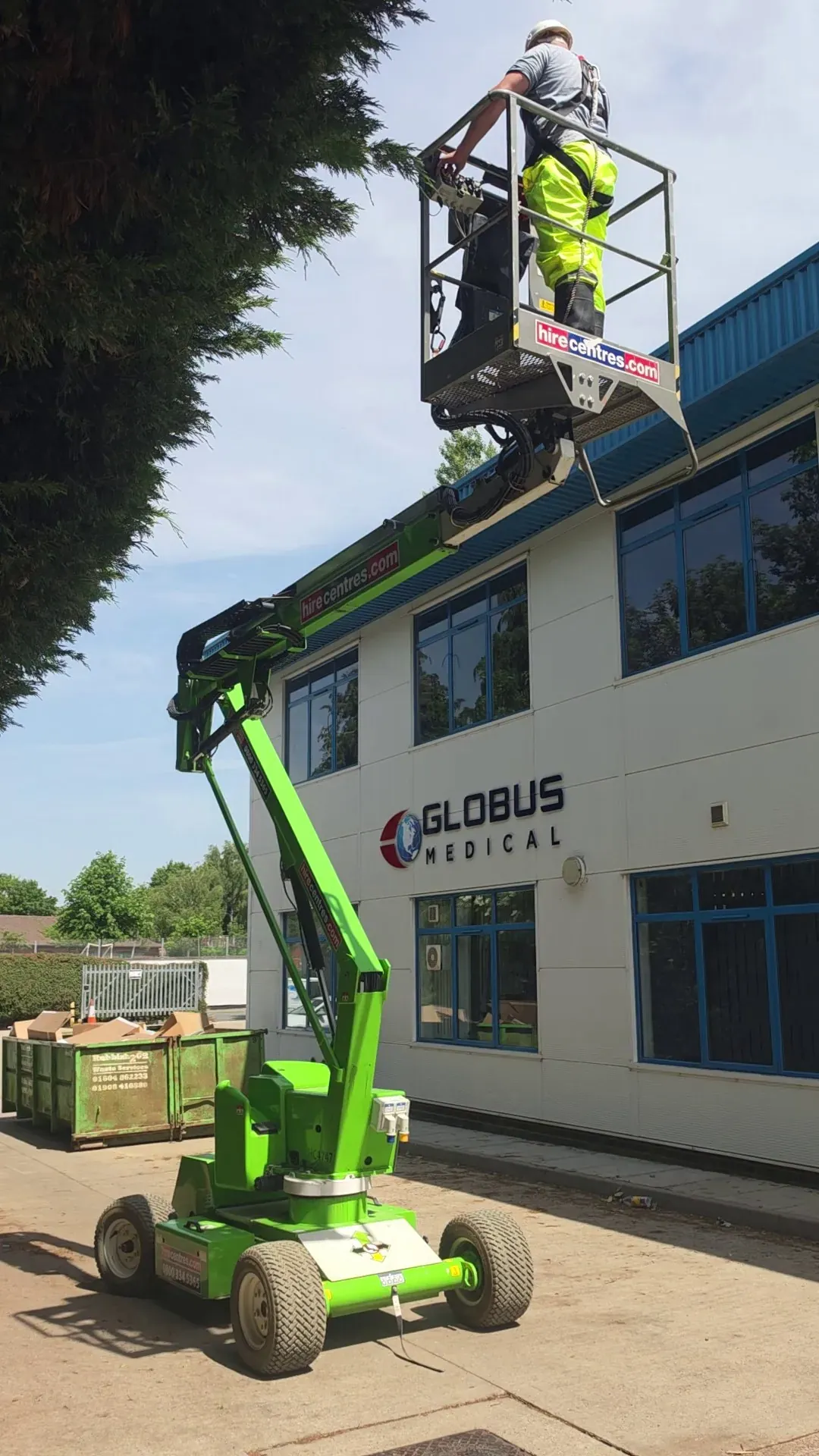
The safest approach to high-level cladding cleaning is to minimise time at height and staff numbers. As per HSE's guidance on working at height, start with: “Can the work be done safely from the ground?” Follow its work-at-height strategy (avoid, prevent, arrest): telescopic poles first, then a MEWP with an IPAF-trained operator, a scaffold tower for small awkward areas, and rope access for tall or complex facades. Until a qualified person confirms otherwise, HSE says to treat every roof as fragile.
The rule every method starts from: the work at height hierarchy
In the UK, the Work at Height Regulations 2005 cover any work where a fall could cause injury, including cleaning cladding at height. According to HSE's guidance for the cleaning industry, the latest fatal injury statistics show that in 2025/26, falls from height caused 31 of the 126 worker deaths in Great Britain, around a quarter of the total. HSE's guidance on assessing work at height asks you to follow the controls order and move to the next option only when the previous one isn’t practical.
The cleaning company isn’t the only one responsible. Anyone who controls others’ work also has responsibilities, such as facilities managers and building owners hiring a contractor for façade cleaning. So, when you hire a cleaning team, ask how they will reach the high areas and why they do so. A responsible contractor will answer at once.
HSE's brief guide to the Work at Height Regulations advises that working at height can be avoided by simply using extending equipment from the ground. For cladding cleaning, that’s typically telescopic, water-fed poles. The poles can’t safely reach? Access equipment preventing falls will follow.
Option 1: from the ground with telescopic poles
Telescopic poles avoid work at height altogether, so they’re HSE's first choice. Its HSE window cleaning guidance names water-fed poles as an example. With telescopic pole cleaning, the cleaner stays on the ground while cleaning the cladding. Typically, the job is faster, cheaper, and less disruptive as there’s no access equipment, scaffolding, platform or ladder to set up.
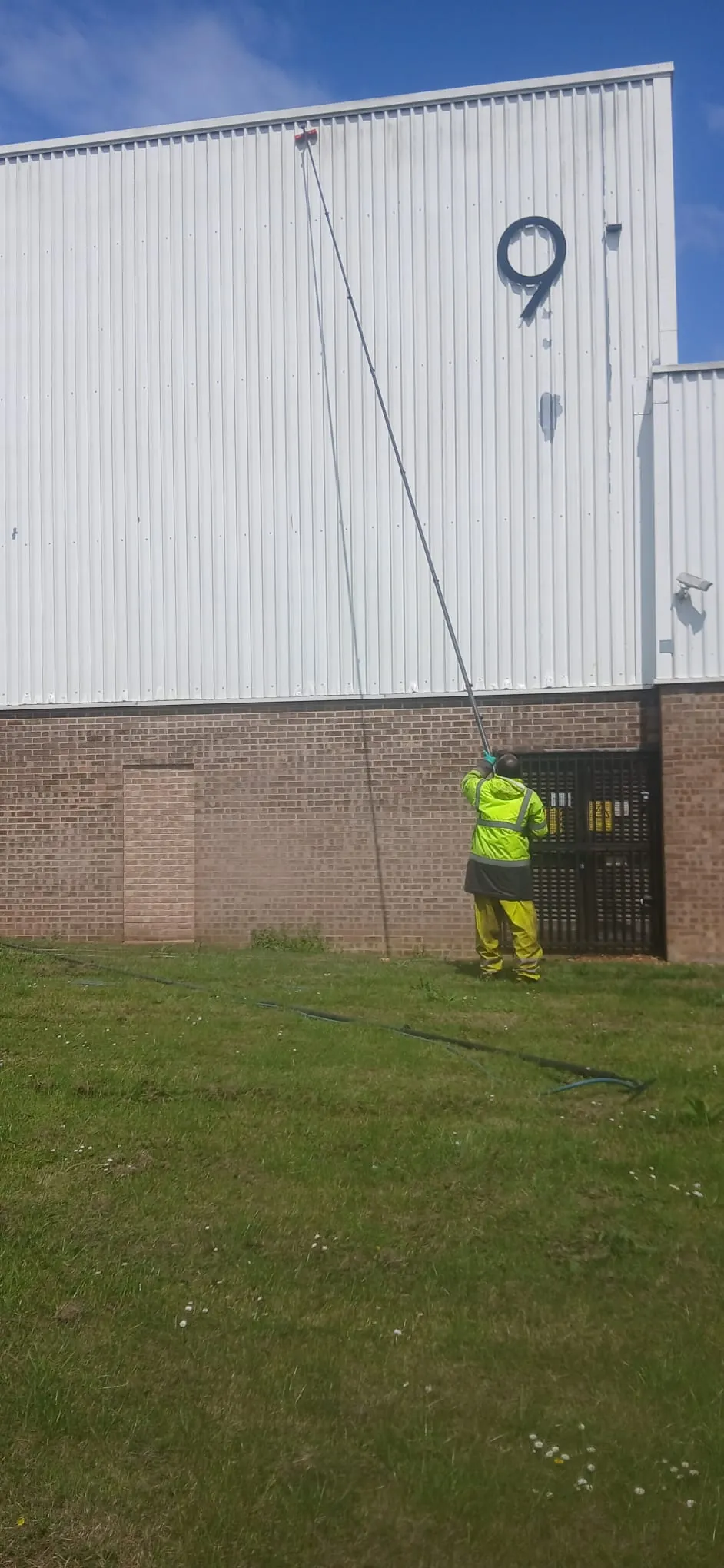
The best-practice guidance on water-fed poles published by HSE says that, with windows easy to see from the ground, a water-fed pole can reach about 24 metres (80 ft) from the ground. It’s different with cladding, which typically requires a cleaning solution and brushing, plus more control at the pole’s end. From the ground, ECS cleans cladding up to about 12 metres, around three to four storeys. Poles limitations? The cleaner needs a clear line of sight and firm footing, and it cannot reach deep canopies or set-backs. When extended, poles lose control.
The biggest hazard with telescopic pole cleaning is overhead power lines. The Federation of Window Cleaners reports that two window cleaners died in 2021 when their water-fed poles touched live cables. Look for overhead lines before starting and as cleaning moves along the building. Consider electrically tested insulated poles if lines are nearby. For details, see HSE's guidance note GS6 on overhead power lines and working safely near overhead power lines.
ECS followed this approach on varied commercial sites. At AJB Group (July 2025), the team cleaned a tall white warehouse in Corby from the ground with a telescopic pole. At Eurofins in Northampton (May 2026), the team used water-fed poles to clean the cladding, porch and parapet; there was no scaffold or powered access. And all four elevations at the Necos.fm unit in Dunstable (April 2026) were cleaned from the ground with extension poles. As Peter notes: "Most of our commercial work is done from the ground with poles. We only bring a cherry picker when the height or a canopy needs it."
Option 2: a MEWP (cherry picker) and an IPAF-trained operator
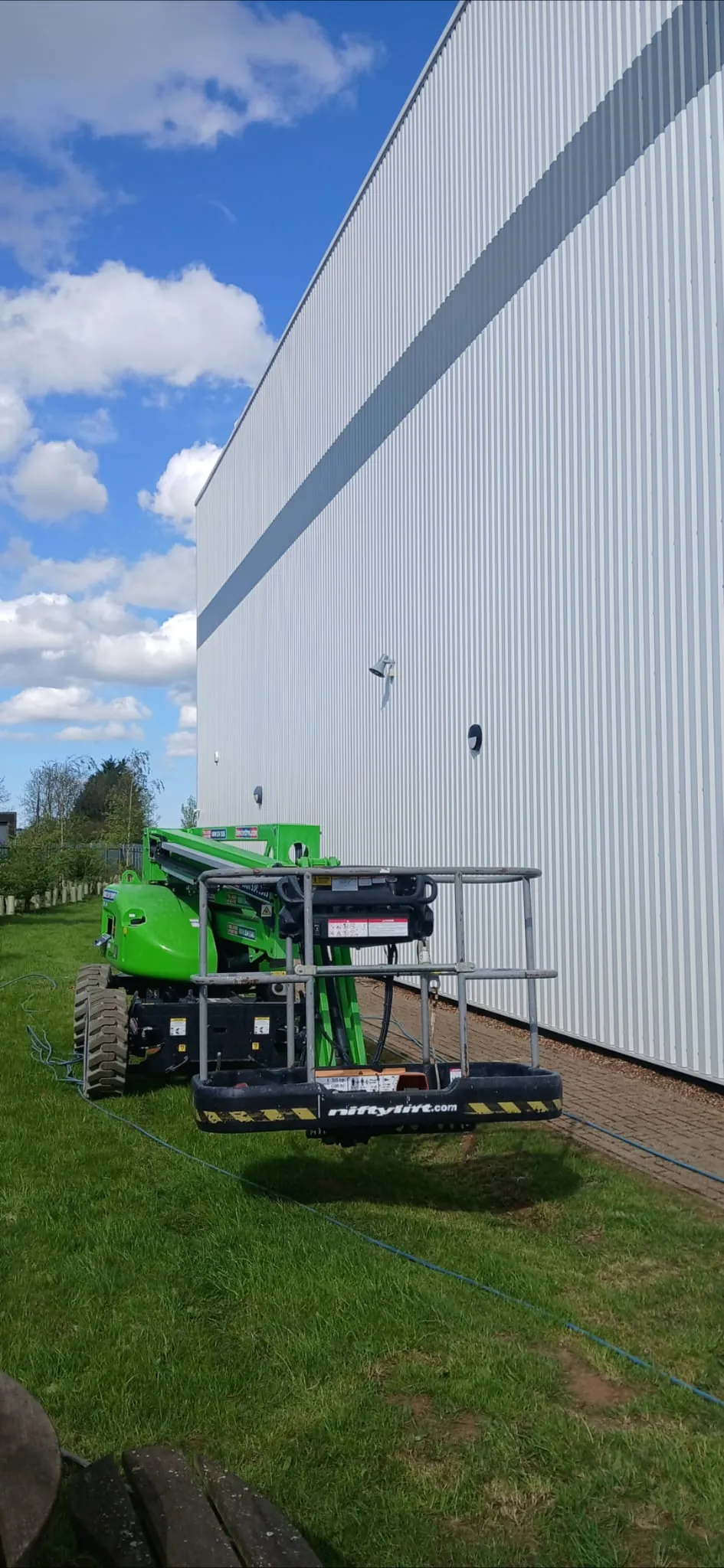
When the poles reach their limit - the cladding is higher than a pole can safely clean, or cleaners can’t see or reach from the ground a deep canopy or set-back - it’s time for the cherry picker. Along with boom lifts and scissor lifts, the cherry picker is one type of MEWP (Mobile Elevating Work Platform). The platform takes the cleaner straight to the surface for close, controlled cleaning of high cladding, roofs, gutters and the awkward areas above entrances.
| Category | Machine type | Examples |
|---|---|---|
| 1a | Static vertical | Vertical personnel platforms (static) |
| 1b | Static boom | Booms on outriggers, trailer-mounted and vehicle-mounted platforms |
| 3a | Mobile vertical | Scissor lifts, mobile vertical platforms |
| 3b | Mobile boom | Self-propelled booms, driven while raised |
Anyone operating a cherry picker should hold an IPAF PAL card (Powered Access Licence). IPAF issues it after an IPAF course and test. The IPAF ePAL app issues the digital card, which is valid for five years. It lists all IPAF's machine categories an operator is trained on.
Different machines require different skills, so categories matter.
Set up on outriggers, static booms (1b) have trailer- and vehicle-mounted platforms. Scissor lifts are Mobile Vertical (3a), while Mobile Boom (3b) refers to self-propelled booms that can move while raised. Is the operator only trained on a 1b? Then they cannot drive a 3b while raised. Similarly, if one was trained only on a 3b, they’re not trained to set up a 1b on spreader pads. The card and the on-site machine must match. Operators in higher-risk or challenging environments can add PAL+, an optional extra day of category-specific training set out in CITB's PAL+ standard. Boom-platform operators (1b and 3b) must wear a harness with a short lanyard that keeps them inside the platform.
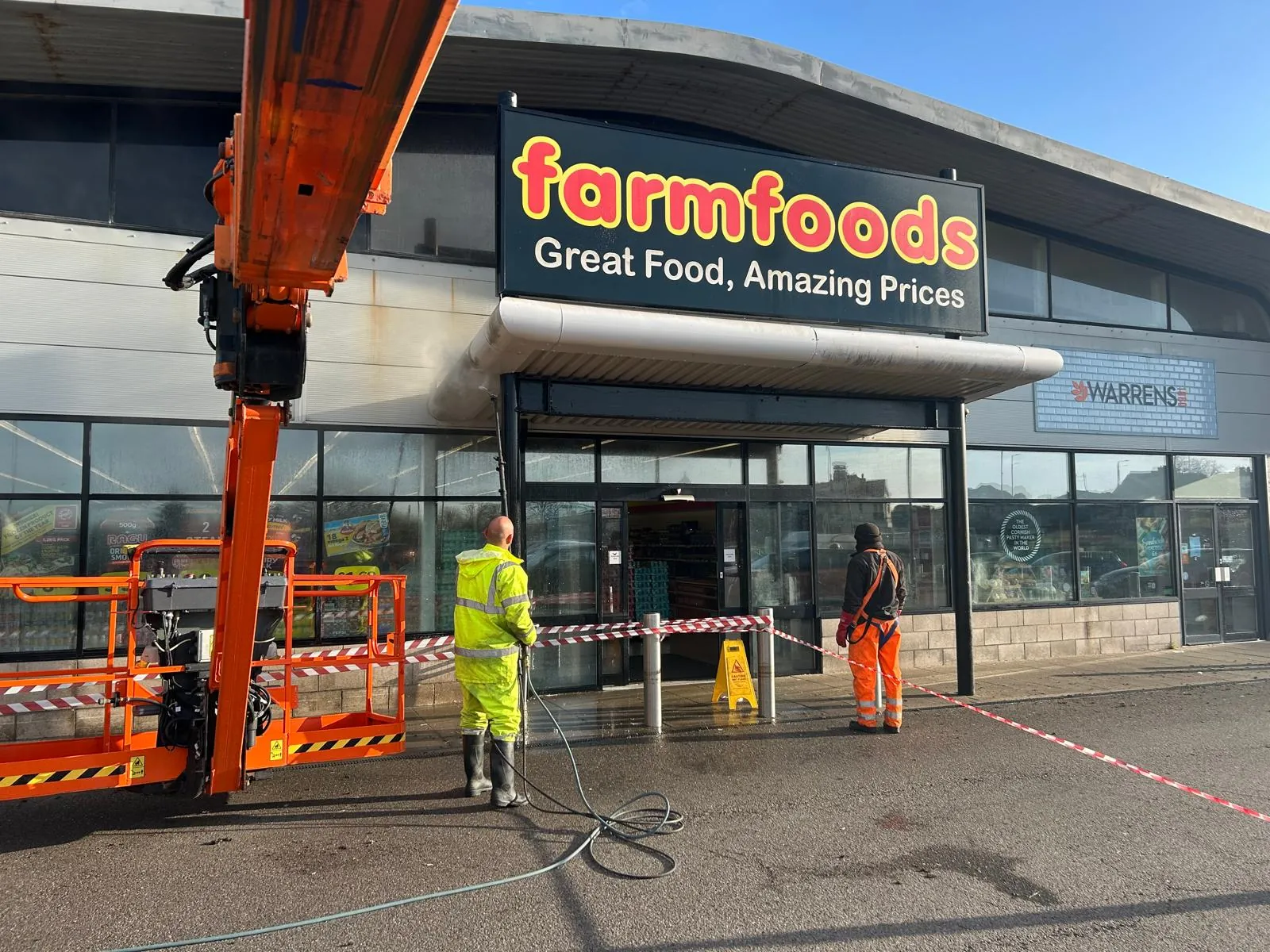
ECS is IPAF- and CSCS-certified, hires its MEWPs and operates them itself, and carries £5M public liability insurance. At the Farmfoods store in Crownhill, Plymouth, the team taped off the areas with a wet-floor sign to keep the store open. They cleaned the roof, cladding, frontage and car park from a boom lift over the entrance canopy and fascia. At a warehouse in Desborough, Kettering, the team accessed the roof, metal cladding, gutters and solar panels from a MEWP. The job took three days and ended with DDAC biocide. For Globus Medical in Northampton (May 2026), we ran a drone survey two weeks earlier to plan a single day of cherry picker work. Across three connected buildings, we applied roof biocide treatment and gutter clearing. A stainless steel gutter proposal came in after recording rust holes in the gutters. And at a multi-wing care home in Chinnor, Oxfordshire (September 2024), the team used a MEWP to clean the building wing by wing.
Option 3: scaffold towers and scaffolding
For a corner, a scaffold tower is the right tool. For the entire elevation? Not so much. A scaffold tower is for small, awkward areas where MEWP can’t get close or can’t be set up, especially if the job doesn’t move for some time. For instance, at the Lung Wah Chong warehouse in Oxford, ECS used a scaffold tower to clean the roofline and side cladding.
It’s different with full scaffolding. ECS typically uses it on residential jobs. Poles or a MEWP are better options on commercial buildings. If a certain area needs the towers, we’ll bring them in.
Option 4: rope access
Tall buildings, high facades above roads, landscaping with no place for MEWP, or buildings with complex shapes -they all call for rope access. Ropes and related equipment take the technician to the work position and support them too. Technicians trained to IRATA (the Industrial Rope Access Trade Association) standards use two ropes: the working one for access and support, and the safety one as a back-up if the first fails. Alongside travelling ladders, gantries and cradles, rope access is listed in HSE's guidance on specialist access. Rope access is often combined with a MEWP; the ropes cover areas the platform can’t reach, and the MEWP reaches the rope anchors.
The catch? The building needs to be ready too. Rope access requires proper anchor points, designed and built into the structure. Many building owners provide and maintain this equipment. They provide contractors with the necessary information and brief technicians on the site. ECS doesn't offer rope access itself. Is it needed? We’ll bring in a specialist rope access partner.
Need High-Level Cladding Cleaned Safely?
We survey the access first, then quote the method - poles from the ground wherever the height allows it, a MEWP when it does not. No upfront deposits, fully insured to £5 million, and backed by 114 five-star Google reviews. Call 07307 358765 for a free assessment.
Get a Free QuoteBefore anyone walks on the roof
According to HSE, 22% of all fall-from-height deaths in construction are through fragile surfaces, especially fibre-cement roofs and rooflights. Until a competent person has confirmed otherwise, HSE's guidance on fragile surfaces says to treat every roof as fragile. No matter the sheeted roof’s material - including the ridge and purlins - it shouldn’t be trusted to withstand a person’s weight.
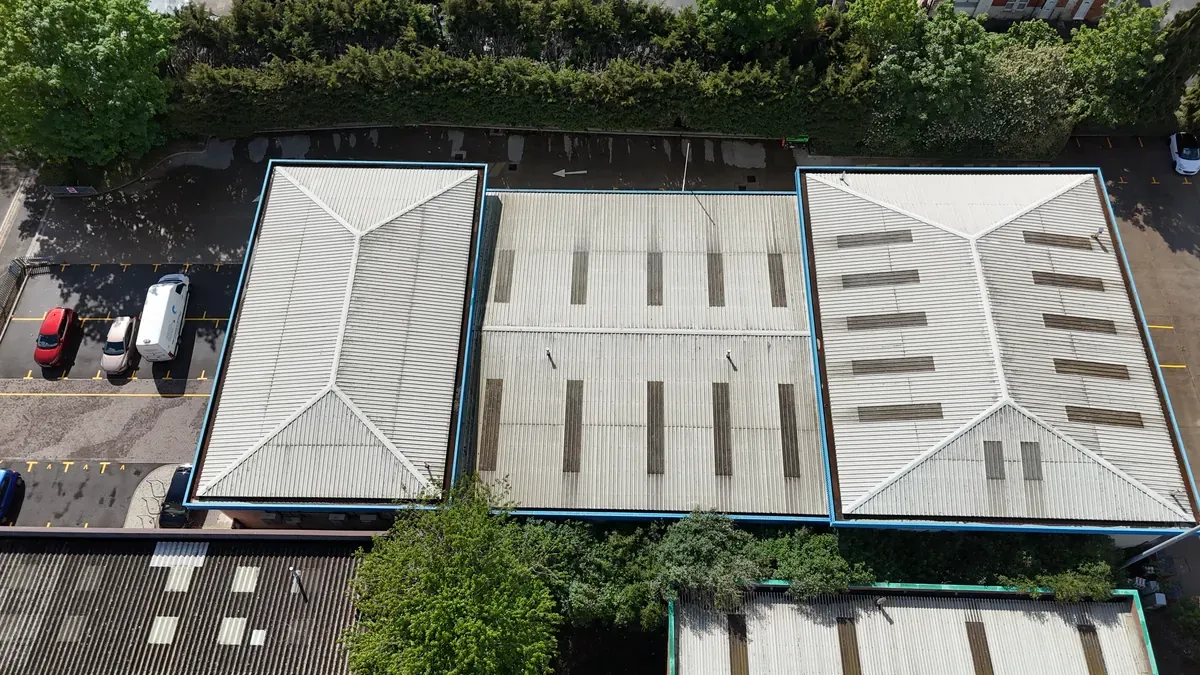
“Non-fragile” is a test result, and not a description. The Advisory Committee for Roof Safety’s Red Book test classes a roof assembly as fragile or non-fragile (class A to C) after checking whether it can take a person falling onto it and support their weight afterwards. Is it non-fragile? The roof isn’t a walkway, and it should stop someone from falling through. NARM, the rooflight manufacturers’ association, highlights that the ratings apply to new roofs. As Tata Steel's 2023 inspection and maintenance guidance shows, corrosion and weathering affect older industrial roofs over time. Roof edges and rooflights remain the main hazards, and two questions are vital before anyone goes up: Was the roof confirmed as non-fragile? What’s the protection?
With ECS, every large job starts with a drone survey to check the roof without setting a foot on it. The team uses a cherry picker to clean the roof, apply the biocide, and clear the gutters from the platform (see how roof biocide works and how long it lasts). Once the roofs are confirmed as non-fragile, ECS may work on industrial roofs, with lifeline or edge protection. Peter notes: “Before a big roof job, we put a drone up first. It shows us everything we need without anyone setting foot on the roof.” At Globus Medical in Northampton, the single-day cherry picker work across three connected buildings happened two weeks after the drone survey.
Choosing the right method
Every building is distinct, and the access method depends on its height, shape, and nearby areas. Learn which method suits each part of the building from the table below.
| Method | Typical reach | Best for | Limits | Who operates it |
|---|---|---|---|---|
| Telescopic poles from the ground | Up to about 12 m on cladding \*; water-fed poles reach windows up to 24 m † | Most single- and two-storey commercial units; first choice under the work at height hierarchy † | Needs a clear view from the ground; overhead power lines †; deep canopies and set-backs | Trained cleaning crew |
| MEWP / cherry picker | Above pole reach; depends on the machine | Canopies, rooflines, gutters, taller elevations | Needs firm ground and space to set up; overhead lines; exclusion zone | IPAF PAL card holder for the right category ‡ |
| Scaffold tower | One area at a time | Small awkward areas where a MEWP can't get close \* | Slow to move; limited height | Trained crew |
| Scaffolding | Whole elevations | In our work, mainly residential jobs \* | Time and cost to erect and dismantle \* | Scaffolding contractor |
| Rope access | Tall and complex facades | Where MEWPs can't reach or stand § | Needs anchor points on the building §; specialist team | IRATA-trained technicians § |
The rule? Always start from the ground and only go up if necessary. The first option is water-fed poles; for parts the poles can’t reach, the team brings a cherry picker, scaffold tower, or rope access. In reality, no single method will be enough on a building. Typically, poles are used for most walls, while the canopy over the entrance calls for MEWP. So, teams work at height only where it's really needed.
What to ask your contractor
Before work at height starts, many building owners and managers brief contractors about the site’s specifications and give them induction. HSE says it’s a common practice. Use that moment to ask your contractor:
- Which access method will they use? Why don’t they use safe ones? †
- Can you get a method statement and risk assessment?
- Did they look for overhead power lines? †
- If they use a cherry picker: does the operator hold an IPAF PAL card for this machine category? ‡
- Is the ground firm enough? Where’s the exclusion zone?
- In case of emergency, how will they lower the platform?‡
- If anyone goes on the roof: was it confirmed by a competent person that it’s non-fragile? What fall protection (edge protection, a lifeline) will they use? †
- What’s their insurance?
These questions are based on guidance from HSE (including GS6 on overhead power lines), the Federation of Window Cleaners and IPAF. Their FAQs also explain the role of the trained person on the ground who helps lower a platform in an emergency. A good contractor will answer at once. For instance, every commercial client gets a written method statement from ECS, which also has £5M public liability insurance. It's also worth asking how often cladding should be cleaned and which cleaning chemicals are safe for your building.
Working on a site that stays open
Many commercial buildings can’t close for a clean. The job has to be done around staff, customers and deliveries. At Farmfoods in Crownhill, Plymouth, we cleaned while the store stayed open. Our team taped off the area beneath the boom lift and placed a wet-floor sign. While we cleaned overhead, shoppers could move safely as needed.
Other sites got the same strategy. Activities ran as usual at Eurofins in Northampton; we’ve marked the area with cones and hoses. At Resort World Birmingham (June 2026), the venue remained open while the team cleaned the curtain-wall glazing, terrace balustrade glass, and a flat skylight. They’ve used water-fed poles and a pressurised rinse for the skylight.
Get a quote
The safest way to clean high-level cladding is to follow HSE’s hierarchy: start from the ground (telescopic poles) and only go up when necessary. Use MEWP with an IPAF-trained operator when necessary, and rope access for very tall or complex facades. Until it’s confirmed non-fragile, nobody should go on the roof.
Around 12 metres with telescopic poles. Water-fed poles reaching windows up to 24 metres are shown in HSE-published guidance. However, in practice, the reach is lower when cleaning cladding with a solution and brush.
An IPAF PAL card (Powered Access Licence) for the correct machine category, issued after an IPAF course and test. It’s valid for five years.
1b booms are static, while 3b can be driven while raised. 1b are set up on outriggers on trailers or vehicles, while 3b are self-propelled. Training on 1b doesn’t cover 3b, and vice versa.
Yes, if done correctly. Trained technicians would use a two-rope system with a backup and a right anchor point on the building. Typically, it’s combined with MEWPs.
Yes. Anyone controlling the work of others, including facilities managers and building owners who hire contractors, has responsibilities under the Work at Height Regulations, according to HSE.
Maybe, but only once a competent person has confirmed the roof as non-fragile, with fall protection, and away from rooflights. HSE reminds us to treat all roofs as fragile until a competent person confirms otherwise. 22% of fatal falls from height in construction are caused by fibre-cement roofs and rooflights. Typically, ECS works from a cherry picker and checks industrial roofs before going up. Then, we use a lifeline or edge protection.
Yes, as long as there are an exclusion zone, barriers, and signage (Farmfoods, Crownhill, Plymouth).
First, ECS runs a free site survey and gives you a written estimate the same day. We accompany every commercial job with a method statement and before-and-after photos. Our team is IPAF and CSCS certified and carries £5M public liability insurance. We have 114 five-star Google reviews and offer maintenance contracts to facilities managers, helping you keep your building looking its best year-round. Call 07307 358765 or request your free quote.
Get a Free Quote