
How Often Should Commercial Cladding Be Cleaned?
Published November 2026
Commercial cladding doesn’t have a fixed cleaning interval: it depends on the building’s location and design. Tata Steel's 2023 inspection and maintenance guidance for pre-finished steel doesn't specify one either. Tata recommends a first-year inspection and cladding cleaning whenever dirt is "visibly apparent". Sheltered areas, like roller door tops, overhanging eaves and the areas under solar panels, require extra attention. In our experience, roadside, industrial and tree-shaded buildings need cleaning every 1-2 years; cleaner sites treated with a biocide, every 3-5 years.
Why there's no single answer: the factors that set your interval
Several factors affect cladding cleaning frequency, and location matters the most. Tata Steel’s guidance points out that on busy roads and industrial estates, cladding picks up dirt faster, especially at corners, around vents, and in gutters. Cleaning on these sites should be done more often, while the lower panels and the road-facing elevations should be inspected first.
| Factor | Effect on the cladding | What to do |
|---|---|---|
| Busy road or industrial estate | Dirt builds up faster † | Shorter interval; check lower panels and road-facing elevations first |
| North-facing or shaded elevation | Stays damp longer, so algae establishes sooner | Inspect these elevations first; biocide after cleaning |
| Sheltered details (eaves, canopies, roller door tops) | Not rain-washed, so dirt and growth collect † | Wash these areas between full cleans |
| Horizontal details (flashings, window heads, copings) | Hold water and dirt | Check at every inspection |
| Overhanging trees | Shade, leaf litter in gutters, droppings | Clear gutters more often |
| Rooftop solar panels | Area underneath isn't rain-washed † | Separate cleaning regime with records ‡ |
| Sea spray | Named in the Confidex guarantee as needing maintenance ‡ | Follow the guarantee's maintenance conditions (rare in Northamptonshire) |
| Older or light-coloured coating | Shows dirt sooner; weathered coatings chalk and hold dirt | Expect more frequent cleans; see the chemicals guide |
Algae settles quickly on slow-drying, shaded elevations and north-facing walls, and comes back quickly if no biocide is applied. Where there's algae or lichen, follow cleaning with a biocide treatment. Is there trapped water or dirt on horizontal details such as window heads, flashings and copings? At a motorsport unit on Silverstone Business Park, areas along the flashing band and the panels right below had green algae. The rest of the wall was cleaner.
Is the coating older or light-coloured? Then dirt shows sooner, while weathered finishes chalk and pick up grime. That’s one of the stains that cleaning won't fix entirely. Areas untouched by rain, like those under rooftop solar panels, need a different approach. On Confidex-guaranteed roofs, the area under solar panels needs regular cleaning, with records kept.
Washed vs unwashed areas (the key concept)
Rain cleans much of a building, but not all areas. And those missed parts are known as “unwashed areas”. Dirt and algae collect there first.
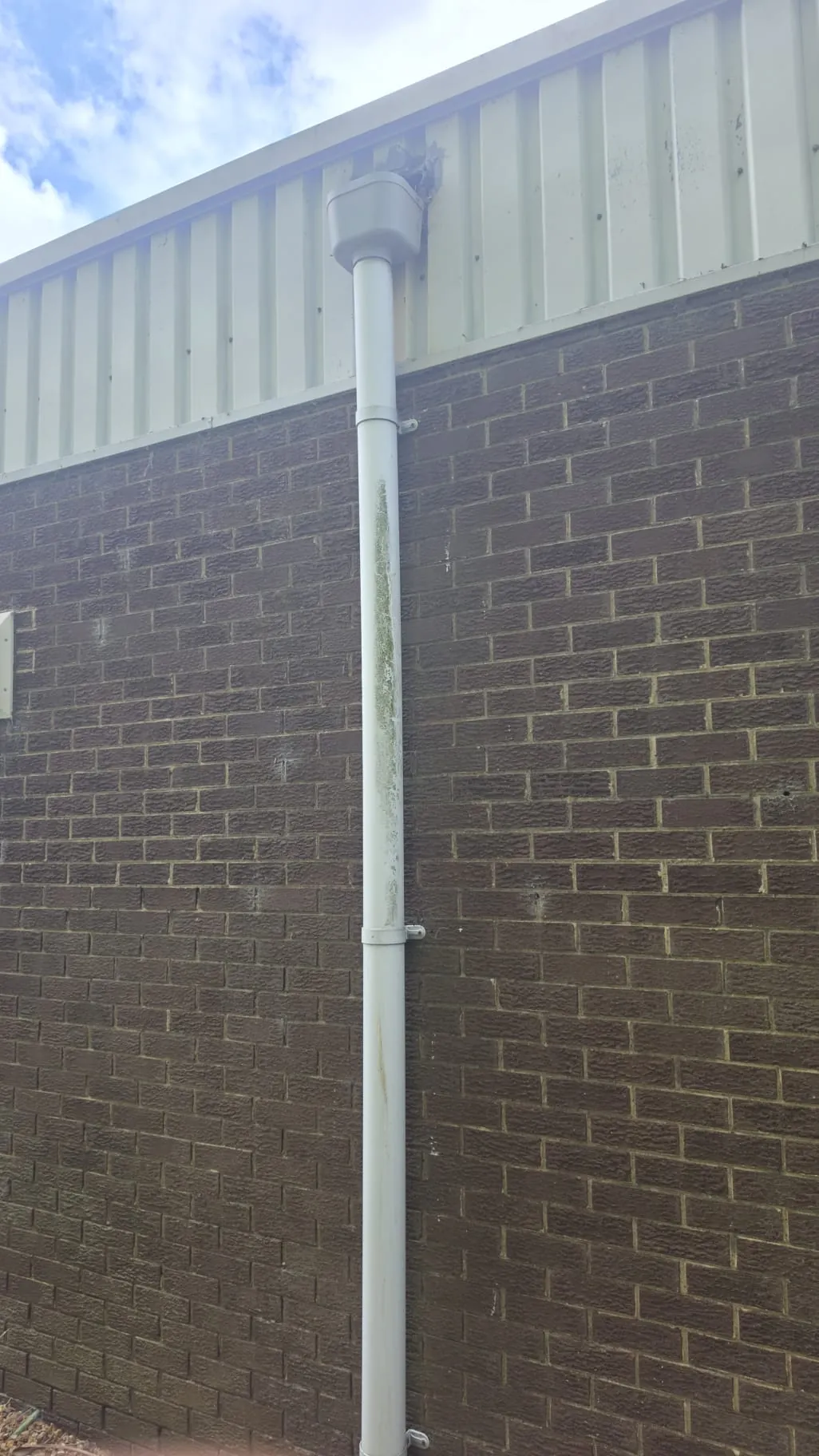
Areas rain doesn't wash:
- Under eaves and along gutter lines †
- Tops of roller shutters and loading-bay doors †
- Entrance canopies and porch roofs
- Horizontal flashings, window heads and parapet copings
- Behind and below signage
- Under rooftop solar panels †
- Around flues, extract vents and air-conditioning units
- Corners, penetrations and gutters, where dirt collects fastest †
Tata Steel mentions typical sheltered spots: the tops of roller doors, overhanging eaves, and areas under solar (PV) panels. Corners, penetrations, and gutters also collect dirt faster than the rest of the building. Kingspan’s Technical Bulletin 7 (New Zealand, 2017) recommends inspecting and washing these areas as needed, especially cladding beneath gutters or eaves.
New Zealand's Metal Roof and Wall Cladding Code of Practice treats all wall cladding as an unwashed area. Unlike roofs, walls get less rain, pick up more dirt and pollutants, and need cleaning more often. NZ Metal Roof and Wall Cladding Code of Practice.
> During our cladding clean at Eurofins in Northampton, we found green-algae streaks coming down the sloped porch cladding from the gutter line. Green algae covered the parapet panels, while the roof gutter had dried moss and grass. From the ground with telescopic poles, we ran a sodium hypochlorite soft wash at low pressure, rinsed, and brushed the porch panels with a pole brush. In the same visit, we cleaned windows and brickwork, and the porch turned a clean cream that afternoon. Peter Gama, who runs ECS, notes: "The dirtiest part of a commercial unit is rarely the middle of the wall. It's wherever water runs off something: under the gutter, below a flashing, down the side of a downpipe."
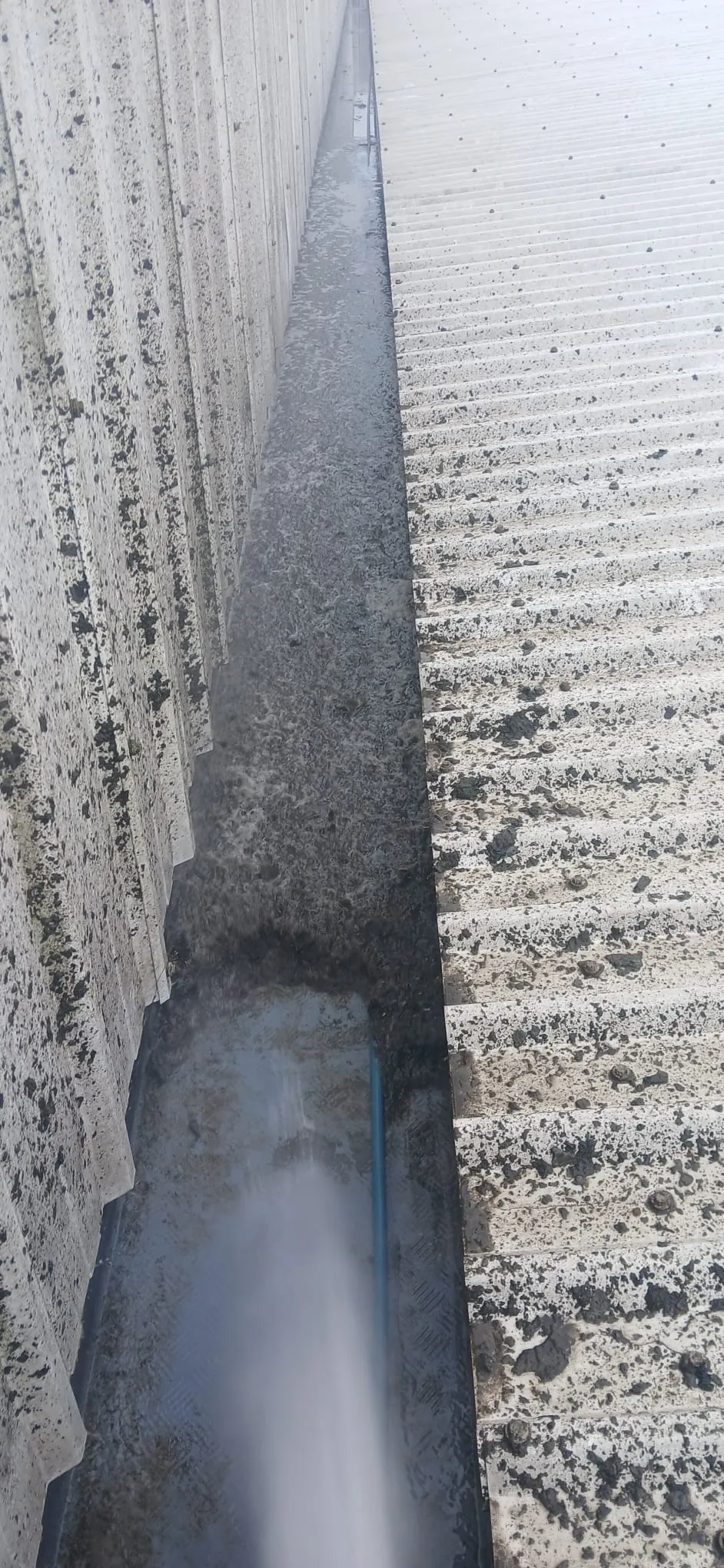
At Partridges, a warehouse in Desborough, debris filled the box gutter between the wall and roof, and the nearby corrugated sheets presented difficult black lichens. In three days, working from a MEWP, we cleaned the cladding, roof, gutters, and solar panels.
What cladding manufacturers actually say (and what your guarantee needs)
Manufacturers approach cleaning differently. Some set fixed intervals, like Kingspan in New Zealand, while Tata Steel doesn't. Tata's guarantees exclude damage caused by built-up dirt. Want the cover to hold? Your cleaning schedule and records should meet the manufacturer's terms.
Tata Steel: what the Confidex guarantee asks of you
Tata Steel's Confidex guarantee covers two coated-steel products, Colorcoat HPS200 Ultra and Colorcoat Prisma, when they’re used as roof or wall cladding (single skin, built-up or composite panel) on industrial and commercial buildings. According to Tata Steel's Confidex datasheet, it lasts up to 40 years; Colorcoat Prisma also has a colour guarantee of up to 20 years, and the guarantee transfers with the building.
Under the terms of Tata Steel's Confidex guarantee, owners of HPS200 Ultra and Prisma cladding need no annual inspections or maintenance to keep the guarantee. To claim, no inspection or maintenance reports are needed. The exception? Cladding exposed to dirt, debris, or sea spray.
Roofs with mechanically fixed PV arrays keep their Confidex cover if Tata's PV addendum is followed. The area under the panels requires maintenance, specifically regular cleaning. Local conditions affect frequency, with "accurate records of cleaning retained for future reference".
> So "no maintenance needed for the guarantee" differs from "never needs cleaning". The exception includes the sheltered areas described above, without any rain wash. Tata Steel's Confidex Home guarantee booklet shows how the dirt clause works in practice: the residential guarantee requires no maintenance except where dirt, debris or salt spray builds up, which requires regular cleaning under Tata’s guidelines.
>
> The guarantee holds with regular cladding cleaning to Tata’s guidelines; a semi-permanent anti-graffiti coating voids it. Confidex only covers HPS200 Ultra and Prisma, as Tata Steel's Confidex guarantee page sets out. Other Colorcoat products (GP, LG and the plastisol range) and other manufacturers’ coatings have their own terms. Check yours!
Kingspan: why your inspection records matter
Kingspan's guidance in New Zealand (Technical Bulletin 7, 2017) recommends that building owners record inspections and maintenance, which become part of Kingspan's manufacturer warranties. Buildings need annual inspections and maintenance, and more frequent if needed. Ideally, walls get cleaned every 6 months, and 3 months in coastal areas. In sea-spray zones, roofs get at least one annual clean. These numbers apply to New Zealand, and UK building owners should review their inspection and maintenance documents and guarantees. Their terms may differ.
Aluminium shopfronts and curtain walls: the annual cleaning rule
To keep Kawneer's architectural finish warranty valid, clean painted aluminium at least once a year to the AAMA 609 & 610 standards, so dirt and salt deposits don't build up. Retail shopfronts and offices with aluminium window and door framing benefit; customers and staff see them daily. Otherwise, the building loses both its appearance and warranty cover.
Overseas guidance - it doesn’t apply to the UK
Australian and New Zealand steelmakers recommend fixed schedules, such as hand-washing wall cladding every 3 to 12 months. That’s related to climate and coastal exposure and isn’t a UK requirement.
What you should do
- Look for the building's O&M (operation and maintenance) manual.
- Determine the cladding system and coating by product name (e.g. Colorcoat HPS200 Ultra).
- Check the guarantee certificate and the building owner's obligations.
- Include all its requirements (inspections, cleaning, records) in the maintenance plan.
A practical maintenance schedule (the table)
Tata Steel's 2023 inspection and maintenance guidance has no fixed interval for the building’s life. It recommends regular inspections based on the building’s location and design. The schedule below combines Tata’s guidance and our on-site experience; each line shows its source.
| Task | How often | Why it matters | Who |
|---|---|---|---|
| Visual inspection of walls, roof edges, flashings, sealants and fixings | First inspection after the first year of occupation †; then at the interval that inspection shows is needed - we recommend at least once a year \* | Catches coating damage, exposed cut edges, failed sealant and corroding fixings early | Facilities manager or surveyor, from the ground, a MEWP or an adjacent building |
| Clear gutters, box gutters, hoppers and outlets | At least once a year; twice a year where trees overhang \* | Debris blocks gutters and causes water to pond † | Cleaning contractor |
| Wash sheltered areas (under eaves, canopies, roller door tops, flashings) | When dirt is visibly apparent †; on roadside or industrial sites typically every 6-12 months \* | Rain doesn't reach these areas, so dirt and growth build up first † | Cleaning contractor |
| Full facade clean | Every 1-2 years on roadside, industrial or tree-shaded sites; every 3-5 years on cleaner sites when a biocide is applied \* | Appearance and coating life; dirt left in place can break down the coating † | Cleaning contractor |
| Biocide treatment (DDAC) | After cleaning, where there's biological growth; inhibits regrowth for 4-5 years \* | Lengthens the interval between full cleans | Cleaning contractor |
| Clean under rooftop solar panels | Regularly, at a frequency suited to local conditions, with cleaning records kept ‡ | A condition of the Confidex guarantee under PV arrays ‡ | Cleaning contractor |
| Check after site events | After nearby building work, PV installation, fire or smoke, graffiti, bird nesting | Swarf, dust, debris and droppings attack coatings | Facilities manager, then contractor |
† Tata Steel's 2023 inspection and maintenance guidance. ‡ Tata Steel's Confidex guarantee, including its PV addendum. \* Our experience on commercial cladding in Northamptonshire and surrounding counties.
Run every inspection with the following checklist. Typically, you can do it from the ground with a pair of binoculars.
| Element | What to look for |
|---|---|
| Roof sheets | Dirt and debris, coating damage, exposed cut edges, penetrations, leftover protective film or adhesive labels |
| Roof fixings | Incorrect, incorrectly fitted or corroding fixings; broken or missing washers or covers |
| Gutters, hoppers, gullies, downpipes | Dirt, fungal growth, coating damage, exposed cut edges |
| Flashings and ridge cappings | Dirt, fungal growth, coating damage, exposed cut edges |
| Eaves and verges | Dirt, fungal growth, coating damage |
| Penetrations (vents, flues, pipes) | Dirt, exposed cut edges |
| Access hatches | Dirt, fungal growth, mould |
| Upstands and parapets | Dirt, fungal growth, coating damage, exposed cut edges, penetrations, leftover film or labels |
| Wall sheets | Dirt, fungal growth, coating damage, exposed cut edges, penetrations |
| Wall fixings | Broken or missing washers or covers; incorrect or corroded fixings |
| Sealants, filler blocks, isolation tape | Perished, mouldy, missing or incorrect |
This checklist follows Tata Steel’s 2023 inspection and maintenance guidance. Inspect from the ground with binoculars, from a MEWP, an access hatch or an adjacent building; don’t walk on the roof.
Use the first inspection as your baseline, and clean whenever necessary afterwards.
Signs it's time to clean (don't wait for the calendar)
Instead of following a set schedule, check cladding for streaks below gutters and ledges, dark staining under sheltered areas, and green algae or moss on shaded walls.
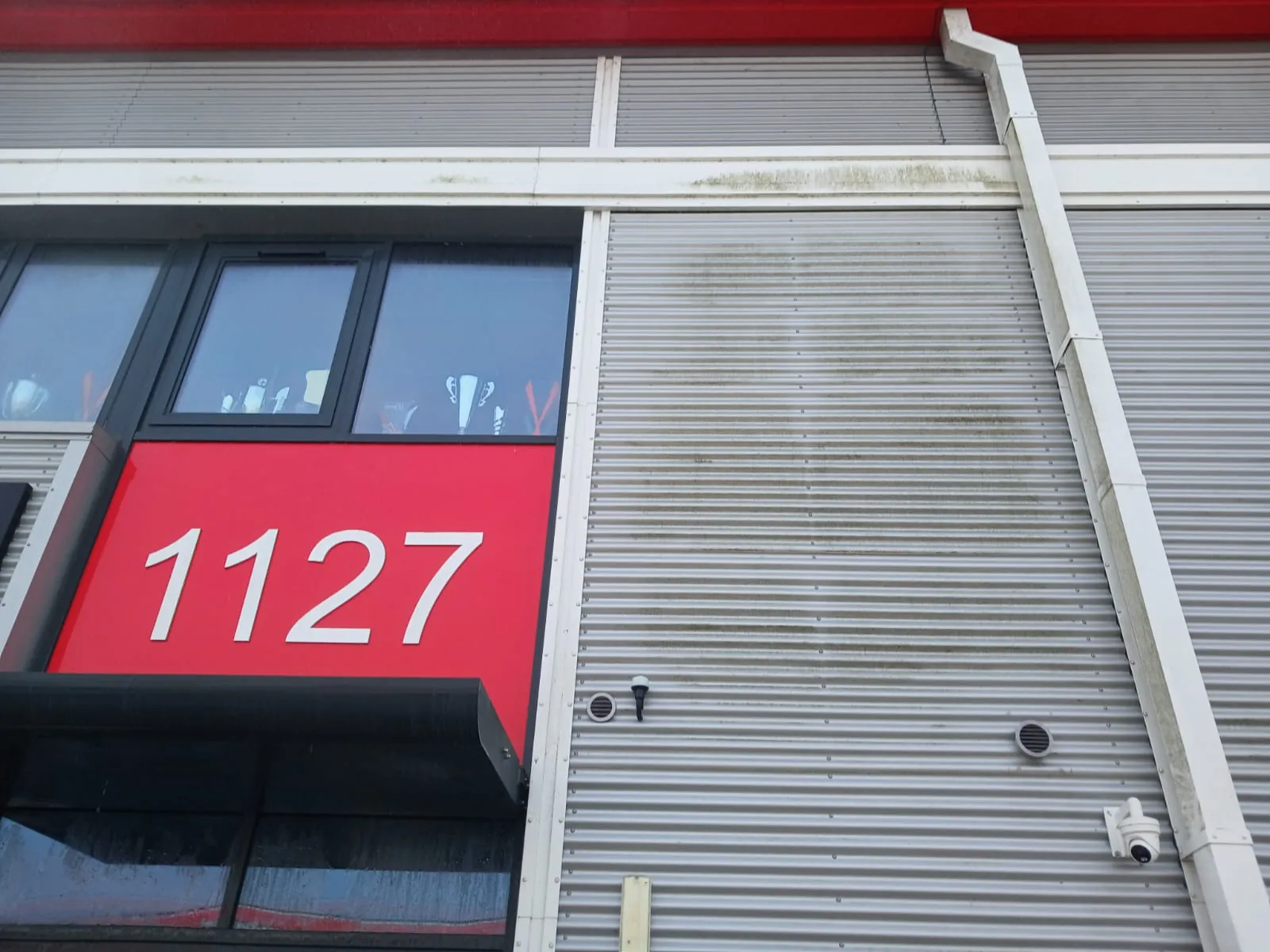
- Green or black streaks below gutters, flashings or window heads
- Algae film on the north elevation or behind trees
- Dark lines along horizontal panel profiles and laps, worst near the ground
- Black or grey lichen spots
- Chalky residue when rubbing a panel
- Rust spots at fixings or cut edges (needs repair also)
- Gutters overflowing in rain, or plants growing inside
- Dull-looking signage and entrance next to neighbouring units
At Eurofins, soil, moss, and small plants filled the gutter behind the roof parapet, with some rusted sections that required replacing. During a steam clean in Dunstable, the bottom of profiled panels had difficult grime, with a light biofilm along the plinth. Lichen grips harder than algae and can leave faint marks on older finishes, even after treatment.
At Partridges in Desborough, we found dense black lichen on the corrugated sheets next to the box gutter. "Lichen is the stubborn one," says Peter. "It shows up as black spots, and on older sheets you can still see where it was after it's dead."
Is there any rust at fixings or cut edges? Tata Steel's 2023 guidance reminds you to check for corroding fixing. Inform the building’s maintenance contractor about rust, as it also needs repair.
Need a Cladding Maintenance Schedule?
We survey the building, tell you which elevations dirty first, and set an interval you can put in a budget. No upfront deposits, fully insured to £5 million, and backed by 114 five-star Google reviews. Call 07307 358765 for a free assessment.
Get a Free QuoteWhat happens if you leave it
Unaddressed dirt affects a building’s appearance and can damage coatings. Debris, dirt, trapped water and chemicals can corrode the metals. Tata Steel’s guidance notes that debris blocks gutters and causes water to collect.
With proper and regular maintenance, Colorcoat pre-finished steel can last more than 60 years (Tata Steel's Colorcoat site guidance). An unsightly cladding isn’t necessarily less functional, and it’s not an emergency. But neglect affects looks first and shortens the coating’s lifespan.
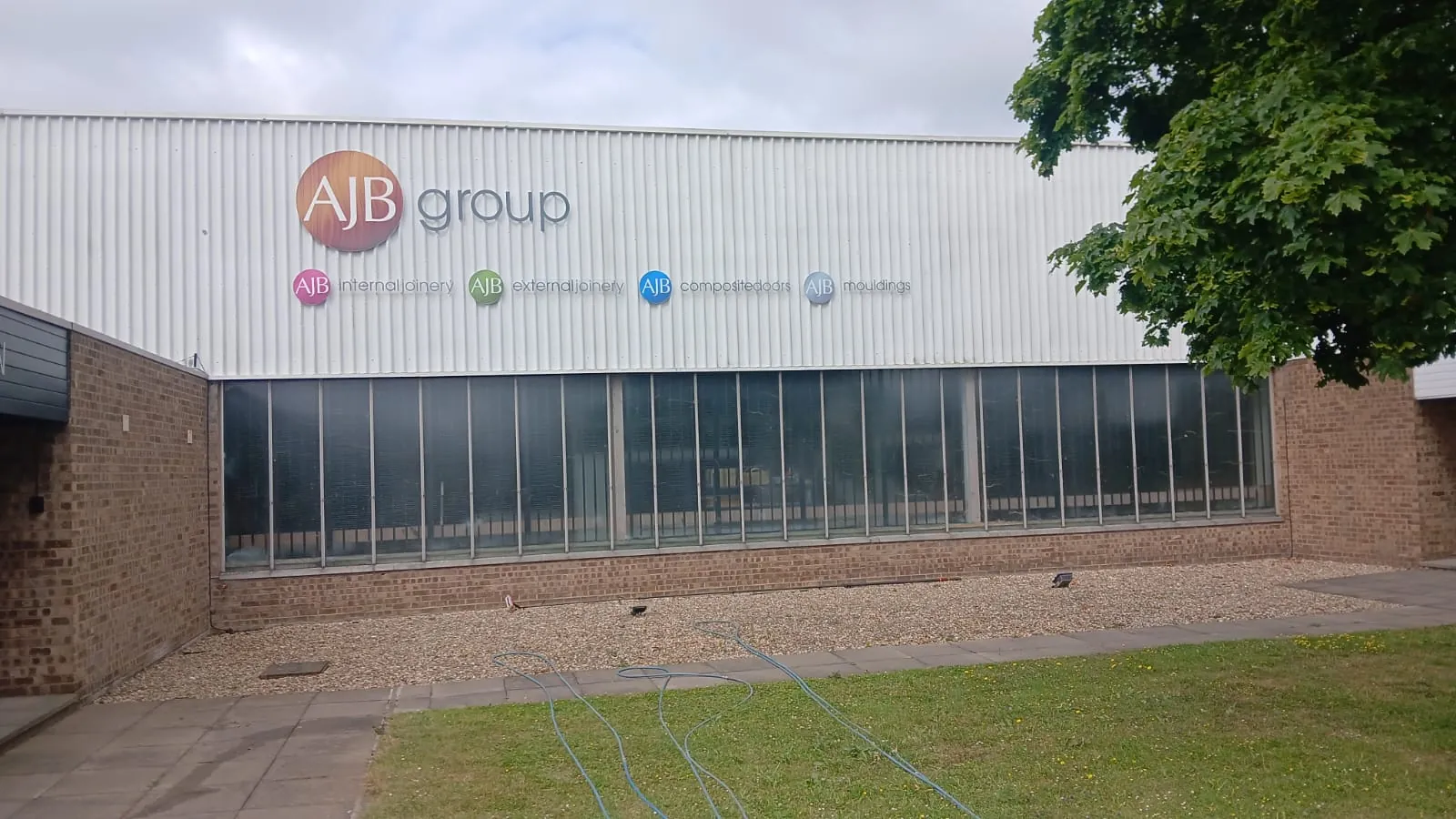
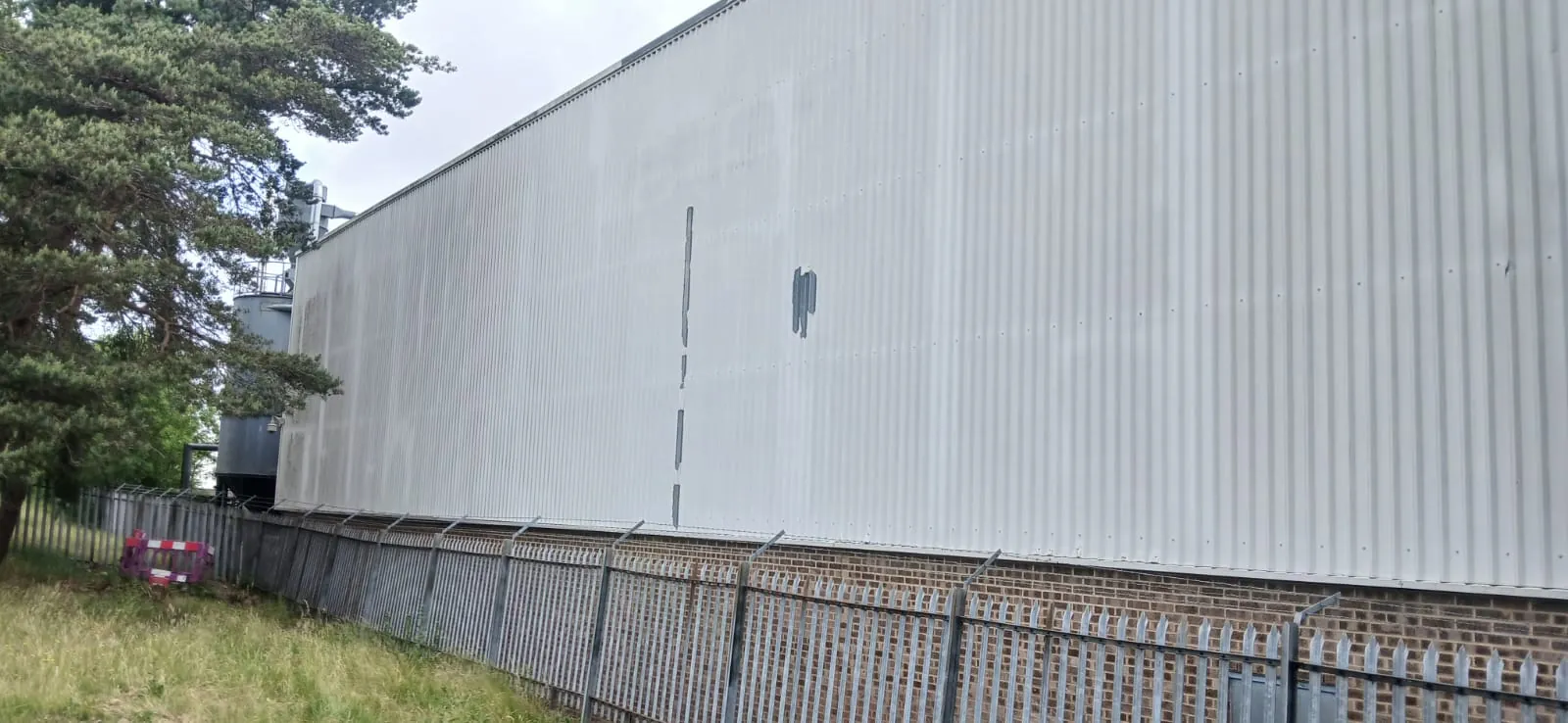
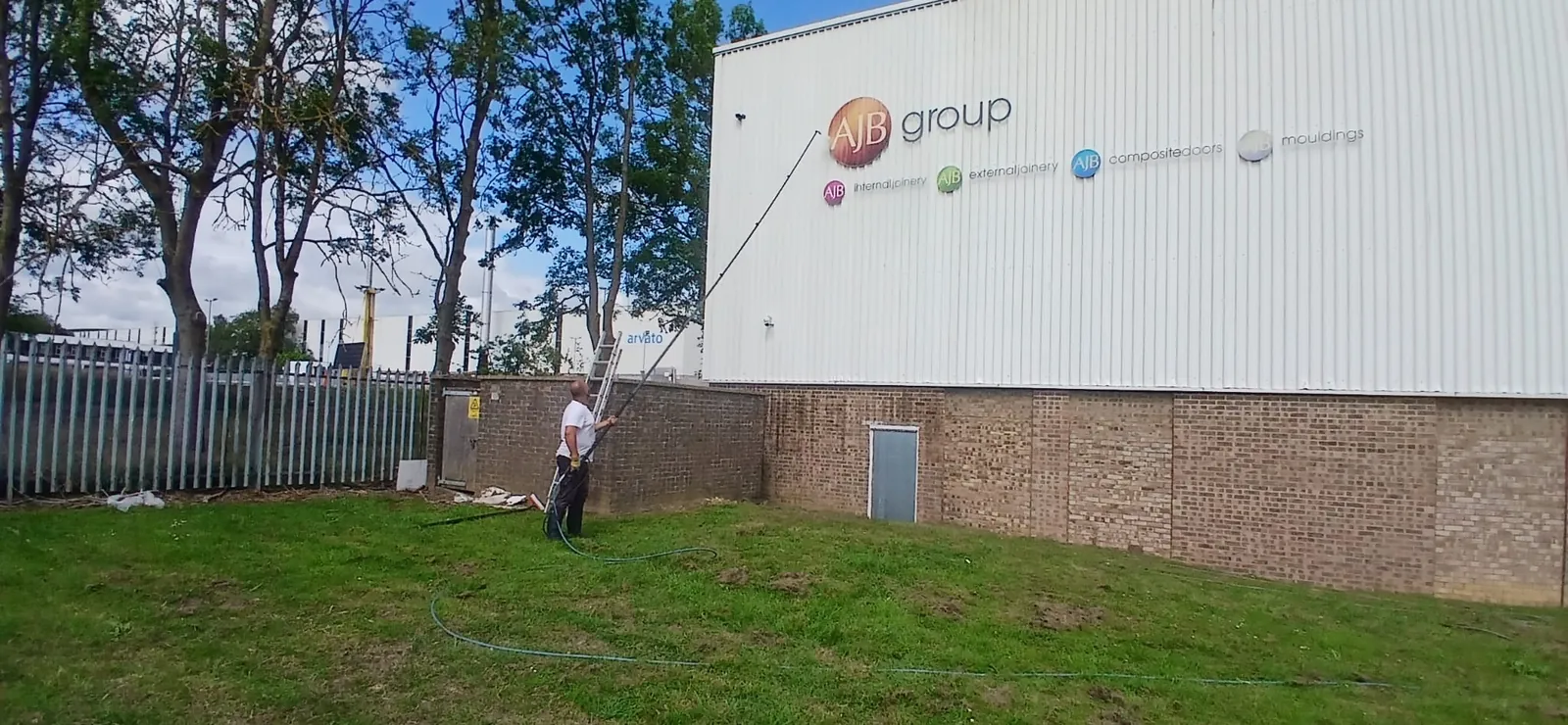
AJB Group's 40,000 sq ft warehouse in Corby hadn't been cleaned in over 20 years. In three days, we fully cleaned the warehouse cladding, extraction tower, ductwork, and roof. At job completion, the client noted that the building "looked brand new".
In April 2026, we cleaned a single-storey unit in Dunstable for Necos.fm. The job was different. The dirt was road film and general grime, and only a light film of algae along the bottom of the panels. From the ground, we ran hot water and finished in around two hours. Peter highlighted: “Not every dirty building needs chemicals. At Dunstable it was road film, not algae. Hot water did the job, and a biocide would have been money spent on nothing."
Inspecting and cleaning safely (work at height)
Tata Steel’s guidance is very blunt: under the Work at Height Regulations, "every effort must be made to avoid having to go on to the roof". Tata recommends inspecting from a cherry picker, an access hatch, or from the ground or nearby building using binoculars.
For most single- and two-storey commercial units, ECS cleans from the ground with 12-metre telescopic water-fed poles (roughly 3 to 4 storeys). "Most of our commercial work is done from the ground with poles," says Peter. No scaffolding or platform is needed. "We only bring a cherry picker when the height or a canopy needs it." For taller buildings, see how to clean high-level cladding safely. ECS is IPAF and CSCS certified and carries £5M public liability insurance.
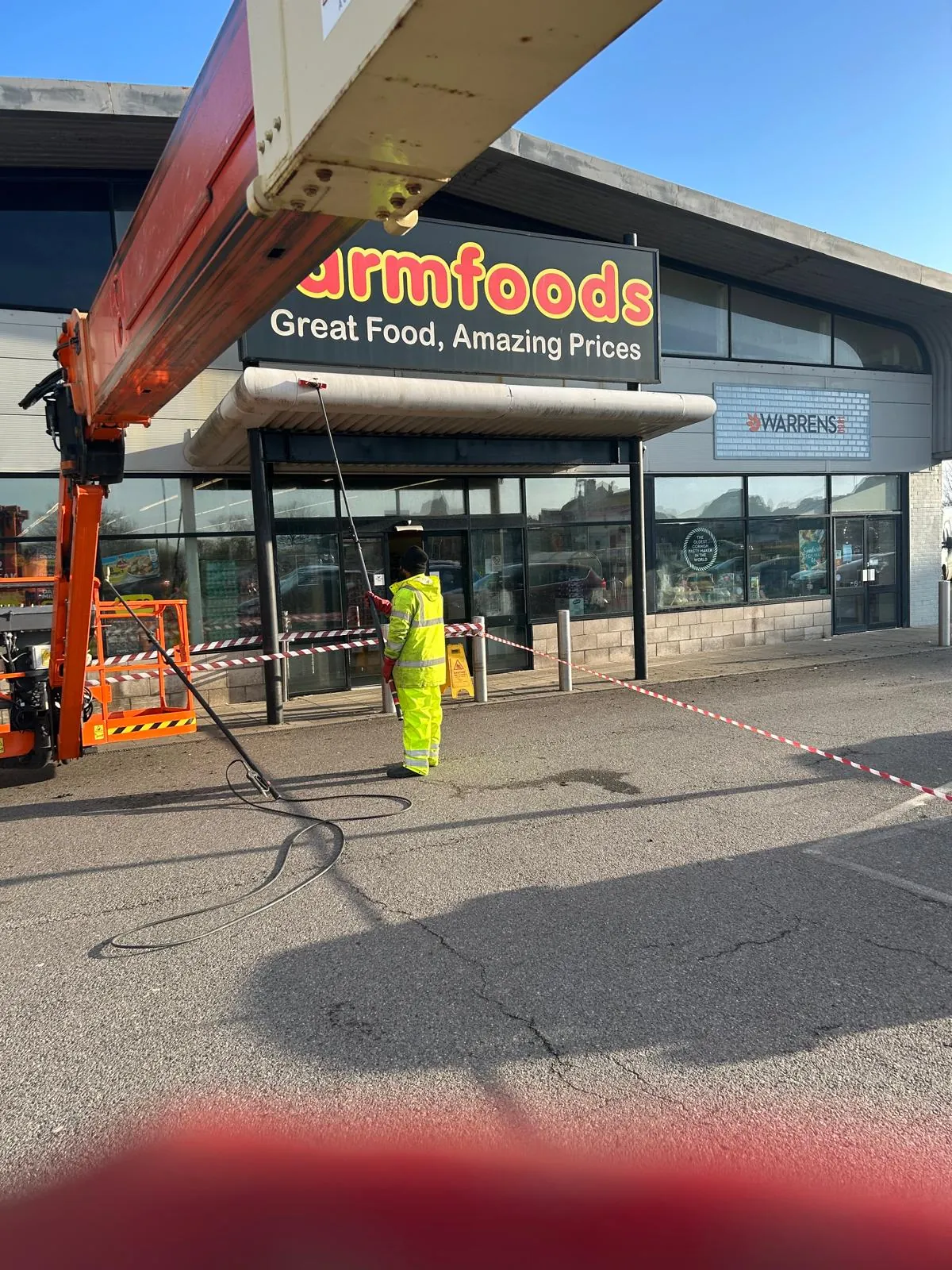
At Eurofins in Northampton and AJB Group in Corby, we worked from the ground with telescopic poles, including a tall warehouse elevation. At the Farmfoods store in Crownhill, Plymouth and Partridges in Desborough, we used a MEWP for the higher sections.
Fitting cladding cleaning around a working building
Typically, buildings stay open during commercial cladding cleaning. At the Farmfoods store in Crownhill, Plymouth, shoppers walked past our taped-off work zone while we used MEWP. At Eurofins, our commercial exterior cleaning in Northampton didn’t cause disruption, as we marked the area with cones and hoses. Extra tip? Agree on access and parking limitations with your contractor, and plan entrance cleaning during slow hours.
Access is often the biggest expense, so clean everything in one go. After cladding cleaning, glass needs a wipe; we did so at a Dunstable unit. At Partridges, we've cleaned the cladding, roof, gutters, and solar panels in one visit. Asking for a cladding quote? The same visit can cover the windows, gutters and solar panels.
ECS also works directly for facilities management companies. In April 2026, Necos.fm commissioned our Dunstable job. Then, we did a post-construction window clean at The Phoenix Collegiate in May 2026, and a window clean at Resort World Birmingham in June 2026.
Start by agreeing the method statement with your contractor. Our March 2026 estimate for a Silverstone site covered a site assessment and risk evaluation, protection of nearby areas, plants, and sensitive surfaces, and full PPE. We applied a controlled sodium hypochlorite solution on the façade, allowed it to dwell, rinsed it, and followed with a DDAC biocide to inhibit regrowth. We finished with a final inspection and removed all waste from the site. Our guide tells you which cleaning chemicals are safe on each panel type , dilution rates, and how we manage run-off.
Budgeting and records
Your planned preventive maintenance (PPM) schedule should include cladding inspections and cleans. Work will be done to your schedule and budget, and you get cleaning records for the guarantee. Check our cladding cleaning prices to plan the cost.
Every cleaning record should include: date, elevations and areas cleaned, the chemicals and methods used, and biocide (if applicable). Include before-and-after photos and the contractor's name.
Manufacturers expect these records. Tata Steel asks for "accurate records of cleaning" for the roof area under solar panels on Confidex-guaranteed roofs. Have PV? That’s not optional. In New Zealand, Kingspan's Technical Bulletin 7 (2017) makes the owner's inspection and maintenance records part of its warranties.
ECS offers most records as standard. Every estimate includes a written method statement, like the Silverstone one above, and photos before and after we clean. At Eurofins, the record included 46 photos from before, during and after the work. In the end, you get a ready-made maintenance record.
Get a Quote
In our experience, every 1-2 years on roadside, industrial, or shaded sites, and every 3-5 years on cleaner sites treated with biocide. Tata Steel’s 2023 guidance doesn’t set a fixed interval; inspect after the first year and clean whenever necessary.
It depends on the manufacturer. Tata Steel’s Confidex guarantee (HPS200 Ultra and Prisma) doesn’t require maintenance, except for built-up dirt, sea spray, and areas under solar panels; these areas need regular, recorded cleaning. Other manufacturers may require annual recorded cleaning; check the O&M manual.
Partially, for open, exposed areas. It’s not enough in sheltered areas. Tata Steel lists areas without natural cleaning: the tops of roller doors, overhanging eaves and areas under solar panels. It also highlights that corners, penetrations, and gutters pick up dirt the fastest.
We recommend at least once a year. Tata Steel recommends a first inspection after the first year of occupancy. This establishes the frequency for later inspections. Don’t walk on the roof; inspect from the ground, a MEWP or an access hatch.
Yes, as long as the dirt is biological (algae, lichen). ECS follows cleaning with a DDAC biocide, as, in our experience, it prevents regrowth for 4-5 years. If the soiling is mostly road film and grime, a biocide isn’t necessary.
Typically, yes. We tape off the work zone, put up signage, and do elevations in turn. At Farmfoods, we cleaned a supermarket during opening hours from a MEWP, behind barriers. There was no disruption to Eurofins' Northampton site activities.
From a few hours to several days. A small single-storey unit in Dunstable took us around two hours, including all four elevations and the windows. We cleaned the large warehouse at AJB Group, Corby (about 40,000 sq ft) in 3 days.
Yes. The records should include: date, areas, method, chemical and dilution, biocide, photos, and contractor. For the area under solar panels on Confidex roofs, Tata Steel requires cleaning records, while Kingspan's guidance in New Zealand sees owner records as part of its warranties.
Does your building need a clean? We’ll come and take a look. Get a clear picture of your cladding’s condition from our free site survey and a written quote - both on the same day. Are you a facilities manager? Reach out to us for scheduled maintenance visits. We don’t ask for upfront deposits, and you only pay when you're happy with the result. Call us on 07307 358765 or request a free quote.
5.0 rating from 114 Google reviews · IPAF and CSCS certified · £5M public liability insurance
Get a Free QuoteSources
- Tata Steel - Colorcoat inspection and maintenance guidance for pre-finished steel building envelopes (2023)
- Tata Steel - Confidex Guarantee: limitations and exclusions
- Tata Steel - Confidex Guarantee datasheet
- Tata Steel - Extending the durability of pre-finished steel
- Kingspan - Technical Bulletin 7: Annual Inspection and Maintenance (New Zealand edition)
- Kawneer - architectural finish warranty
- NZ Metal Roof and Wall Cladding Code of Practice - maintenance
- Tata Steel - Confidex Guarantee
- Tata Steel - Confidex Home explanatory booklet